
Executive Leadership Development with Paula E. Simeon explores how faith and leadership intersect beyond traditional boundaries. Each episode invites listeners to move from a parochial view of Jesus Christ’s influence—limited to personal spirituality or church life—toward an expansive, transformative understanding of His impact on modern leadership, societies, and systems.
Through insightful teaching, real‑world examples, and Spirit‑led dialogue, Paula E. Simeon challenges executives, entrepreneurs, and change‑makers to see Christ not only as Savior but as the ultimate model for visionary leadership. This series equips listeners to lead with integrity, compassion, and Kingdom purpose in every sphere of influence—from boardrooms to communities.



Moving from the Parochial View of Jesus Christ's Influence on Modern Day Leadership, Societies, and Systems, to an Expansive Transformative View. By Paula E. Simeon
Gary (2007) argued that the conceptualization of what Jesus would do on issues of climate change, fuel efficiency, pro-life issues, Jesus’ identity and several other highly debated often contentious topics, from both liberals and conservatives viewpoints, adopted a narrow sectarian positions, but ignored the first-century context, and the evolving, transformative, immersive, expansive nature of Jesus leadership and his timeless, ageless, relevant transformative influence on all humanity, systems, structures, government and societies, created a vast knowledge gap in our fast-paced chaotic times.
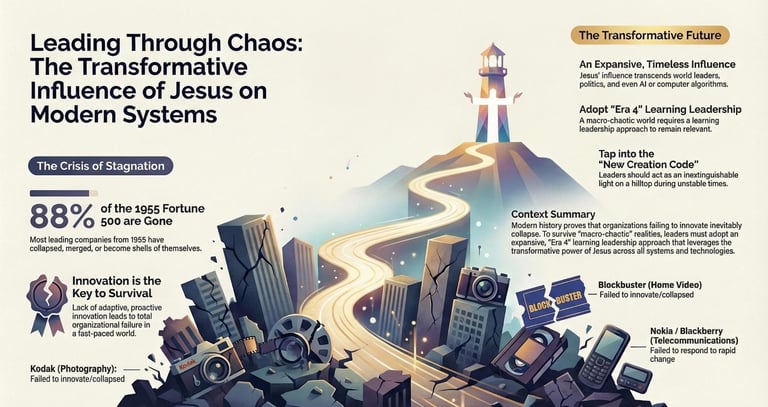
A transformative open system approach that recognizes the Macro-Chaotic realities of our modern-day world, using a Learning Leadership approach, Era 4, as proposed by Richard Daft’s model of leadership evolution, would be a more suitable approach to our 21st-century chaotic and rapidly evolving world. Jesus is both relevant and influential across ages and generations, is real and expansive, and transcends times, technologies, world leaders, and politics.
Organizations that fail to innovate die. Modern history and track record show that 88% of Fortune 500 companies that existed in 1955 no longer exist. Some of these companies are Kodak camera, Blockbuster movie rental, Toy r Us toy store, Pan AM airline, Borders bookstore, Xerox, Nokia, and Blackberries phones are just a few of the thousands of organizations which has either collapsed, merged into another entity or existed as shell of what it used to be due to a lack of adaptive proactive innovation (Goh, 2025; Valuer, 2022).
Jesus Christ, whom heaven must retain until the transformation of all things (Acts 3:21). How can we, the new creation, fortunate occupants of planet earth, awaken to the reality of heaven on earth, the desire of our creator, let it be on earth as it is in heaven? Can the 21st-century leaders and organizations learn that no one and nothing is too big to fail? How can we future-proof our organizations? Does Jesus’ relevance extend beyond the pulpits? Can Jesus' power, presence, and person of the Holy Spirit decode any computer algorithm, or supersede AI? Should Christians sell all, move to live in caves in anticipation of Global meltdown, or should they tap into the life and energy of the new creation code embedded in them, to be an inextinguishable light on the hilltop, to light this dark world in unstable times?
Reference List:
Bible gateway. Bible, Acts 3:21. https://www.biblegateway.com/verse/en/Acts%203%3A21
Gary, J. E. (2007). What would Jesus lead: Identity theft, leadership evolution, and open systems. Journal of Biblical Perspectives in Leadership, 1(2), 89-98.
Valuer (2022). 50 Brands that Failed to Innovate. Accessed 8.23.2025. Published <July 28, 2022> . Location: https://www.valuer.ai/blog/50-examples-of-corporations-that-failed-to-innovate-and-missed-their-chance
Goh, F. (2025). 10 Companies That Failed To Innovate, Resulting In Business Failure. Accessed 8.23.2025. Location: https://www.collectivecampus.io/blog/10-companies-that-were-too-slow-to-respond-to-change